
January 13, 2026
Hiring You Guide: Expert Strategies for Success in 2026

The hiring landscape in 2026 is evolving at lightning speed, making the quest for top talent more competitive and high-stakes than ever. As a hiring manager, recruiter, or business owner, mastering the art of hiring you is now essential to your organization’s success.
This guide provides expert, actionable strategies designed to help you win in the modern talent market. You will discover emerging hiring trends, a step-by-step recruitment framework, the impact of technology, how to elevate candidate experience, and ways to future-proof your approach.
Get ready to unlock the tools and insights needed to transform your hiring you journey and build a winning team for 2026.
Understanding the 2026 Hiring Landscape
The hiring you process in 2026 has undergone a dramatic transformation, driven by rapid advances in technology and shifting workforce dynamics. Organizations are rethinking every stage of recruitment to keep pace with unprecedented change. The pressure to secure top talent is higher than ever, pushing leaders to adapt strategies that were unthinkable just a few years ago.

Artificial intelligence is now integral to hiring you strategies. AI-driven platforms analyze candidate profiles, automate screening, and predict job fit with remarkable accuracy. According to Gartner's 2026 Talent Acquisition Trends, over 70 percent of organizations have adopted AI-powered tools for sourcing and selection, resulting in faster decision making and improved quality of hire. Remote work normalization has also accelerated, with more than half of all new hires working fully or partially offsite. This trend has forced companies to rethink not only where work happens, but how they connect with talent worldwide.
One of the most significant shifts in hiring you practices is the move toward skills-based recruitment. Employers are prioritizing demonstrated competencies over traditional degree requirements. Recent industry studies show that 62 percent of job postings in 2026 emphasize skills and relevant experience rather than formal education. This approach opens doors for a more diverse candidate pool and helps organizations fill roles that require rapidly evolving technical knowledge.
Diversity, equity, and inclusion have become non-negotiable in the hiring you landscape. Companies are embedding DEI principles into every aspect of recruitment, from crafting inclusive job descriptions to implementing unbiased screening processes. For instance, organizations using structured interviews and anonymized candidate evaluations report a 40 percent increase in the diversity of new hires. These efforts not only align with social expectations but also drive innovation and performance within teams.
The global reach of remote-first policies has expanded access to candidates, but it has also intensified competition. Businesses now compete for talent not only with local rivals but with organizations across continents. As a result, hiring you strategies must be agile and responsive to a broader, more dynamic talent market. Job descriptions have evolved to reflect essential remote skills, adaptability, and cultural fluency, rather than just technical requirements.
Recent data highlights the challenges and opportunities in today’s market. The average time-to-hire has increased by 15 percent since 2022, largely due to more thorough screening and higher candidate expectations. Candidate drop-off rates remain a concern, with nearly one in three applicants abandoning lengthy or unclear processes. However, companies that invest in clear communication, transparent timelines, and streamlined application steps achieve significantly better engagement.
Forward-thinking organizations are already reaping the benefits of these changes. For example, tech firms leveraging AI and remote collaboration tools have reduced their time-to-hire by 25 percent, while retailers with strong DEI programs report higher retention and employee satisfaction. The hiring you process in 2026 is both more complex and more rewarding, offering those who adapt a clear competitive edge.
To succeed in this new era, leaders must embrace continuous learning, experiment with emerging technologies, and foster an inclusive culture. The hiring you journey is no longer linear or predictable, but with the right strategies, it can unlock exceptional talent and drive long-term success.
Step-by-Step Guide to Building a Winning Hiring Strategy
Building a successful hiring you strategy in 2026 requires a structured and adaptive approach. The market has changed, and so must your process. A robust hiring you plan covers everything from forecasting talent needs to closing offers. Below, we break down each critical stage to help you attract, assess, and secure the best talent in a fiercely competitive landscape.

Workforce Planning and Role Definition
Every effective hiring you strategy starts with clear workforce planning. Begin by aligning your talent acquisition goals with broader business objectives. Use predictive analytics to identify future skill gaps and map out the roles you will need as your organization evolves.
Data-driven workforce planning involves collecting internal performance metrics and external market trends. Companies that forecast talent needs accurately respond faster to market shifts and reduce costly hiring you mistakes. For example, organizations leveraging workforce analytics have reported increased retention and more strategic hiring you decisions.
By defining roles with a forward-thinking mindset, you ensure that each job profile supports long-term growth. Incorporate flexibility and adaptability into role descriptions to keep your hiring you approach resilient in the face of change.
Crafting Compelling Job Descriptions
A well-written job description is your first point of contact with potential candidates. In 2026, candidates expect clarity, inclusivity, and transparency from hiring you teams. Use gender-neutral language and focus on essential skills and competencies rather than rigid degree requirements.
SEO best practices are vital for visibility. Optimize titles and summaries to ensure your hiring you opportunities attract diverse, qualified applicants. Research shows that clear, inclusive postings can boost application rates by up to 30 percent.
Regularly update your job templates to reflect evolving business needs and industry standards. This commitment to clarity and relevance signals that your hiring you process values both the role and the individual behind the application.
Sourcing Top Talent in a Competitive Market
To build a strong hiring you pipeline, diversify your sourcing channels. Tap into professional networks, online talent marketplaces, and employee referrals to reach both active and passive candidates. Creative approaches, such as targeted campaigns on niche platforms, can give your hiring you strategy an edge.
Proactive outreach is increasingly important. Engage with potential candidates before roles open to build relationships and keep your talent pool warm. Social recruiting and employer branding on platforms like LinkedIn and Instagram amplify your reach and showcase your culture.
Talent pipelining ensures that your hiring you process remains agile and responsive, even as competition for top talent intensifies. By consistently engaging prospects, you reduce time-to-hire and increase offer acceptance rates.
Screening and Shortlisting with Data-Driven Methods
Modern hiring you processes rely on structured, data-informed screening. Replace gut instinct with standardized evaluation criteria and skills assessments. This reduces bias and ensures that every candidate is measured against the same benchmarks.
Leverage analytics to identify high-potential applicants quickly. Companies using data-driven recruitment methods report higher quality hires and more efficient workflows. Structured scorecards and automated screening tools streamline the hiring you journey.
For more information on these techniques, see data-driven recruitment methods. By prioritizing objective data, you build a hiring you process that is both fair and predictive of future success.
Conducting Effective Interviews
Interviews are the core of your hiring you decision-making. Use structured formats with behavioral questions to evaluate competencies consistently. Panel interviews bring diverse perspectives and minimize individual bias.
Prepare interviewers with clear frameworks, so every candidate receives a comparable experience. This ensures that hiring you decisions are based on merit and fit rather than subjective impressions.
Organizations that standardize interviews see improved hiring you outcomes and a stronger correlation between interview performance and job success. Consistency here is key to building a reliable and equitable hiring you process.
Making the Right Offer and Closing Top Candidates
The final step in your hiring you strategy is extending a compelling offer. Speed and transparency are essential, as top candidates often juggle multiple opportunities. Clearly communicate your value proposition and be ready to negotiate on terms that matter most to the candidate.
Competitive compensation, benefits, and growth opportunities increase offer acceptance rates. Data indicates that organizations with streamlined offer processes experience up to 20 percent higher acceptance.
Maintaining open lines of communication throughout the hiring you process reassures candidates and builds trust. A positive closing experience can turn new hires into brand advocates, strengthening your hiring you reputation for the future.
Leveraging AI and Automation for Smarter Hiring
Artificial intelligence and automation are revolutionizing how organizations approach hiring you in 2026. The shift is unmistakable: companies are embracing next-generation tools to streamline processes, reduce manual labor, and secure top talent faster than ever before.
AI now powers every stage of the hiring you journey. From sourcing through onboarding, intelligent algorithms analyze massive volumes of candidate data with unmatched speed and accuracy. Resume parsing tools extract relevant skills and experiences in seconds, while predictive analytics forecast which applicants are most likely to succeed. These advancements enable recruiters to focus on relationship-building and high-value tasks, rather than sifting through endless resumes.
One of the most significant benefits is the reduction of unconscious bias in hiring you decisions. By leveraging structured data and removing subjective filters, AI helps ensure fairer, more equitable outcomes. Automated screening and shortlisting not only boost efficiency but also support diversity and inclusion goals. According to recent research, organizations that implement AI in recruitment see an average 40 percent decrease in time-to-hire and a 30 percent increase in qualified candidate pools. For a deeper dive into the numbers and trends, AI's Impact on Hiring Trends in 2026 offers valuable insights.
Transparency and explainability remain top priorities. As AI systems guide hiring you decisions, it is crucial for organizations to understand how algorithms work and to monitor for potential bias. Many platforms now offer audit trails and clear logic paths, helping hiring managers maintain oversight and trust throughout the process.
Early adopters of AI and automation are gaining a clear competitive advantage. Not only do they fill roles more quickly, but they also attract higher quality talent and improve the overall candidate experience. As the hiring you landscape grows more complex, those who invest in smart technology position themselves for long-term success.
How AI Recruitment Platforms Like Klearskill Drive Results
AI recruitment platforms, such as Klearskill, are setting new standards for hiring you in 2026. These solutions empower organizations to automate candidate screening, eliminate unconscious bias, and generate hyper-relevant shortlists with impressive speed.
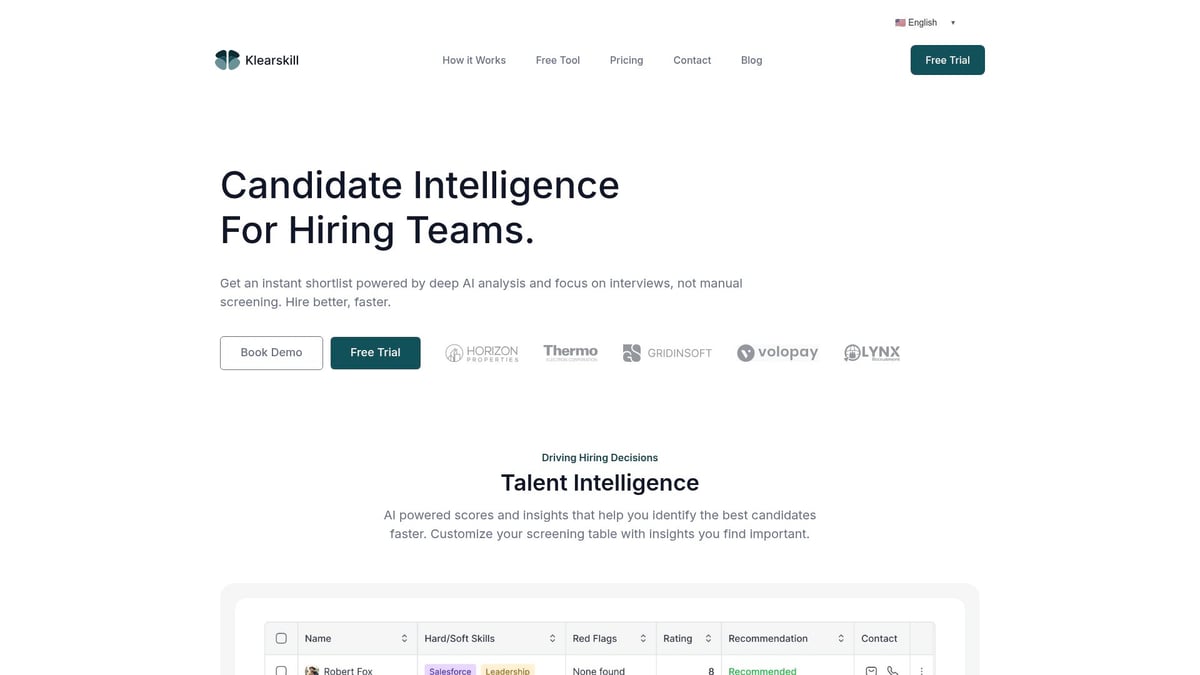
Klearskill’s customizable AI analysis evaluates thousands of applications in minutes, seamlessly integrating with existing applicant tracking systems. Its visual workflow management simplifies every step, allowing recruiters to oversee processes and make data-driven decisions. Companies using Klearskill have reported a 92 percent reduction in screening time and a 99 percent decrease in bias, demonstrating the platform’s effectiveness.
Both startups and large enterprises benefit from advanced analytics, candidate ranking, and plug-and-play deployment. These features not only accelerate hiring you processes but also improve accuracy and fairness. By leveraging real-time insights and predictive analytics, organizations ensure they are consistently selecting the best-fit candidates for every role.
The real-world impact cannot be overstated: faster time-to-hire, increased quality of hires, and a stronger employer brand. In a competitive market, platforms like Klearskill offer a critical edge, making hiring you smarter, more efficient, and more equitable for all involved.
Elevating the Candidate Experience for Long-Term Success
In 2026, candidate experience has become a make-or-break factor for organizations aiming to secure top talent. The hiring you process is no longer just about filling roles, it is about building lasting impressions that influence your company’s reputation and future success. With competition for talent fiercer than ever, those who prioritize candidate-centric practices gain a distinct edge.
Today’s candidates expect a seamless, transparent, and personalized journey from the first interaction to onboarding. The hiring you strategy must recognize that every touchpoint shapes perceptions, from the job posting to the final offer and beyond. In a market shaped by instant feedback and social transparency, even a single misstep can impact your employer brand and deter future applicants.
The modern candidate journey begins long before applications arrive. It starts with employer research, social media presence, and peer reviews. Candidates assess your company’s values, DEI commitments, and flexibility, often before you ever reach out. Your hiring you approach should ensure that these digital impressions are positive and authentic, setting the stage for meaningful engagement.
During the application phase, clarity and accessibility are crucial. Streamlined application forms, quick responses, and visibility into the process make candidates feel valued. Automated updates and self-service scheduling tools reduce uncertainty, allowing hiring you to maintain momentum and minimize drop-off rates.
As candidates progress, timely and personalized feedback becomes essential. Constructive feedback, even for those not selected, fosters goodwill and encourages future applications or referrals. Companies excelling in hiring you consistently communicate at every stage, creating a sense of partnership rather than a transactional process.
Business leaders are seeing tangible benefits from investing in candidate experience. Organizations with standout hiring you practices report higher acceptance rates, stronger referral pipelines, and an enhanced employer brand. For example, several leading tech firms have implemented dedicated candidate support teams and real-time status dashboards, resulting in a measurable increase in positive reviews and repeat applicants.
Optimizing the hiring you journey requires actionable strategies. Begin by mapping every candidate touchpoint, identifying friction points, and implementing improvements. Leverage technology for automated updates and personalized communication, but never lose the human touch. For a deeper dive into practical solutions that drive results, explore how to improve candidate experience, which offers proven tactics for elevating each stage of the process.
Do not overlook the critical role of post-offer engagement and onboarding. Maintaining contact after an offer is accepted, sharing resources, and introducing new hires to team culture ensures a smooth transition. This final phase of the hiring you journey is key to retaining top talent and building long-term loyalty.

Measuring and Improving Candidate Experience
Effective measurement is essential for elevating the hiring you process. Start by tracking key metrics such as Candidate Net Promoter Score, time-in-process, and offer-to-acceptance rates. These indicators reveal how candidates perceive every stage of the journey.
Regularly gather feedback through surveys or post-interview check-ins. Use open-ended questions to uncover specific pain points and opportunities for growth. Analyzing this data enables hiring you teams to implement targeted improvements that resonate with future applicants.
Adopt digital tools that monitor candidate sentiment in real time. Platforms offering analytics dashboards help you visualize trends, compare results across departments, and set benchmarks for continuous improvement. Consistent measurement and refinement ensure that hiring you remains aligned with evolving expectations and maintains a competitive advantage.
A commitment to ongoing evaluation and adaptation transforms candidate experience from a one-time project into a core component of organizational success. By prioritizing these strategies, you build trust, loyalty, and a reputation that attracts high-caliber talent for years to come.
Future-Proofing Your Hiring Approach: Trends and Predictions for 2026 and Beyond
The hiring landscape is evolving faster than ever, pressing organizations to rethink their strategies. To stay ahead, it is essential to anticipate the trends that will define hiring you in 2026 and beyond. Companies that adapt quickly will not only attract the best talent but also create resilient teams ready for whatever the future brings.
Emerging Trends Reshaping Recruitment
In 2026, hiring you will be shaped by several transformative trends. Skills-based talent marketplaces are gaining traction, shifting focus from traditional qualifications to demonstrable abilities. This approach allows organizations to tap into a broader, more diverse talent pool and match candidates to roles based on real-world skills.
Remote-first organizational models have become the new standard, expanding access to global talent. While this increases competition, it also allows companies to source the best candidates regardless of location. Virtual reality is beginning to play a role in interviewing and onboarding, offering immersive experiences that help both candidates and employers assess fit more accurately.
The Rise of Skills-Based Marketplaces
The shift toward skills-based hiring is significant. By prioritizing competencies over degrees, organizations can identify high-potential candidates who may have been overlooked in the past. Digital platforms now enable employers to assess technical, cognitive, and soft skills through standardized tests and project-based evaluations. This evolution ensures that hiring you is focused on what truly matters for success in each role.
Forward-thinking companies are already using these platforms to reduce time-to-hire and improve job matching. As this trend accelerates, expect more businesses to refine job descriptions and evaluation criteria to align with actual business needs.
Remote-First Organizations and Global Talent
Remote work is no longer an exception; it is the expectation. Companies that embrace remote-first models can access a worldwide talent pool, making hiring you more competitive and dynamic. However, this shift brings challenges, including managing different time zones, ensuring cultural alignment, and complying with various employment regulations.
Successful organizations are investing in technology and processes that support seamless remote collaboration. They are also prioritizing flexibility, which has become a top demand among candidates. This flexibility, coupled with a clear remote work policy, positions companies as employers of choice in an increasingly borderless market.
Technology’s Expanding Role in Hiring
AI, automation, and advanced analytics are transforming every stage of the recruitment process. Predictive analytics help organizations forecast talent needs and identify workforce trends, allowing for proactive hiring you planning. Virtual reality is emerging as a tool for realistic job previews and immersive onboarding, providing candidates with a genuine sense of company culture and job expectations.
To learn more about how technology is shaping recruitment, see AI's Role in Modern Recruitment, which outlines the growing importance of combining human connection with digital innovation.
Navigating Labor Laws and Workforce Fluidity
Evolving labor laws and the rise of gig and contract work are redefining employment relationships. Global mobility is now a key consideration, as organizations hire across borders and navigate different regulatory environments. This fluidity requires robust compliance frameworks and an understanding of local labor standards to ensure smooth hiring you processes.
Companies must stay informed about legal changes and adapt their policies to avoid costly missteps. Flexible work arrangements and transparent contracts are essential for attracting and retaining top freelance and contract talent.
Future-Proofing Strategies: Steps to Take Now
To future-proof hiring you, organizations should invest in upskilling and continuous learning for their teams. Embracing flexible work models and fostering a culture of adaptability are critical. Data-driven decision-making, supported by advanced analytics, enables smarter workforce planning and better hiring outcomes.
Leading companies are already implementing these strategies, gaining a competitive edge in the race for talent. For actionable insights on adapting your approach, explore Hiring best practices for 2026, which provides practical guidance for building a resilient recruitment strategy.
The future of hiring you is dynamic and full of opportunity. By staying informed, leveraging technology, and prioritizing skills and flexibility, your organization can thrive in the evolving talent landscape.
As we've explored, hiring in 2026 is a whole new landscape—competition is fierce, candidate expectations are higher, and technology is reshaping every step. If you're ready to put these expert strategies into action and see how AI can truly elevate your recruitment process, why not experience it firsthand? With tools that instantly analyze and rank candidates, you can build a winning shortlist in moments and focus your energy where it matters most. Take the next step toward smarter, faster, and fairer hiring—Start free trial and see the difference for yourself.


