
March 17, 2026
AI CV Screening Software: How It Works and Why It Beats Manual Shortlisting
Most hiring managers spend between 6 and 10 seconds scanning a CV. With hundreds of applications arriving for a single role, the result is predictable: strong candidates get skipped, weak ones slip through on keyword luck, and everyone wastes hours they can't get back.
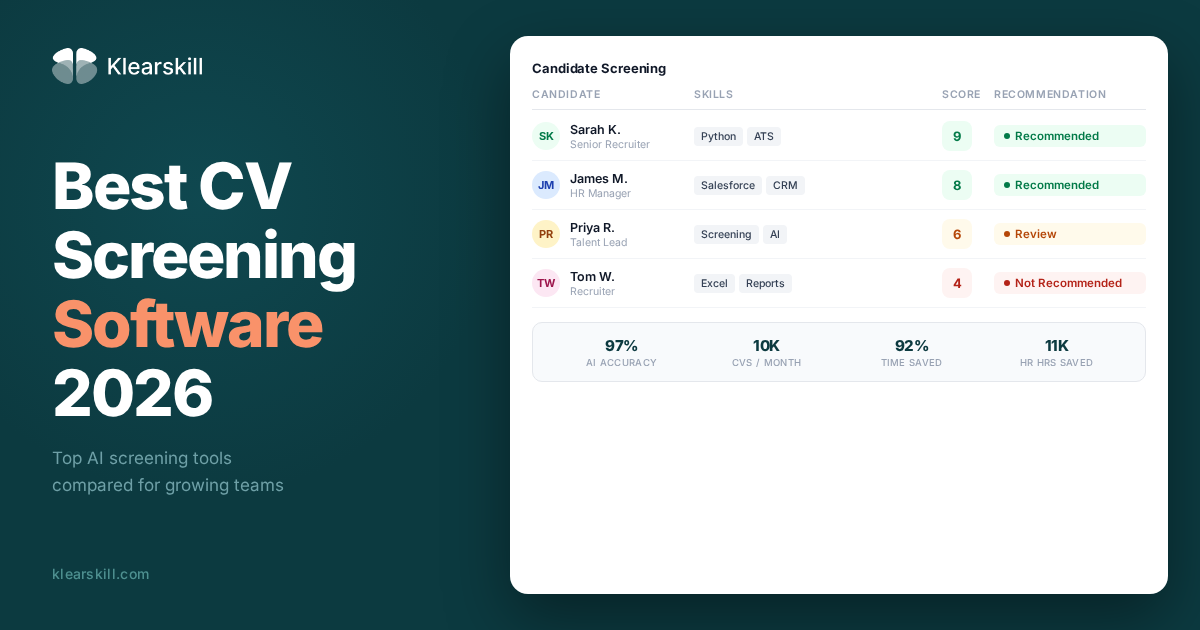
AI CV screening software changes the equation. Instead of a human triaging every resume manually, an AI model evaluates each application against the specific requirements of the job - scoring, ranking, and flagging candidates before a recruiter reads a single line. The result is a dramatically shorter shortlist with substantially higher signal quality.
This guide covers how AI CV screening actually works under the hood, what to look for when evaluating tools, and how modern platforms like Klearskill are making this technology accessible without a six-figure implementation budget.
What Is AI CV Screening Software?
AI CV screening software is a class of recruitment technology that uses machine learning and natural language processing to parse, evaluate, and rank incoming job applications. Rather than applying simple keyword filters (the approach most legacy ATS tools take), AI screening tools attempt to understand context - recognising that a "software engineer with Python experience" and a "Python developer" describe overlapping skill sets even when the exact words don't match.
The best tools go further. They extract structured information from unstructured documents (messy PDF resumes, LinkedIn exports, varying date formats), normalise it into comparable data, and then score each candidate against a rubric derived from your job requirements. Some tools also factor in signals like career progression, tenure patterns, and skill adjacency.
The output is usually a ranked shortlist with score breakdowns - giving recruiters a clear rationale for why each candidate ranked where they did, rather than a black-box decision.
How the Screening Process Works - Step by Step
1. Ingestion and Parsing
When a candidate submits their CV (PDF, Word doc, plain text, or via a form), the AI parsing layer extracts every meaningful field: name, contact information, work history, job titles, employers, tenure, education, certifications, and skills. Good parsers handle edge cases gracefully - misaligned columns, graphics-heavy templates, international date formats, and role titles that vary by industry or region.
2. Job Requirement Extraction
Simultaneously, the system parses your job description to identify what it's actually looking for: required skills, preferred skills, experience level, educational background, and any hard filters (location, right to work, minimum years in a relevant role). Some platforms ask you to define this rubric manually; others infer it automatically from your job post.
3. Scoring and Ranking
Each parsed CV is then scored against the rubric. The AI weighs required skills more heavily than preferred ones, accounts for recency (experience five years ago matters less for a current role), and flags candidates who meet every hard requirement versus those who partially qualify. The result is a score - often expressed as a percentage match - with a breakdown by dimension.
4. Shortlist Generation
Candidates above a threshold automatically move to a shortlist. Hiring managers can adjust the threshold, review the score breakdowns, and make overrides. The AI recommendation is exactly that: a recommendation, not an irreversible decision.
5. Automated Communication
The best platforms tie screening directly to automated candidate communications. Shortlisted candidates get a personalised next-steps email. Those below the threshold receive a polite rejection. All from your own email domain, without anyone clicking "send" manually.
Manual Screening vs. AI Screening: A Practical Comparison
| Factor | Manual Screening | AI CV Screening |
|---|---|---|
| Speed per application | 6-10 seconds average | Under 1 second |
| Consistency | Varies by reviewer fatigue and bias | Identical criteria applied to every CV |
| Volume capacity | ~50-100 CVs/day per recruiter | Thousands per day (Klearskill: 10,000/month) |
| Score transparency | Subjective and hard to audit | Score breakdown per candidate |
| Bias risk | High (name bias, photo bias, order effects) | Lower (no name/photo in scoring model) |
| Cost at scale | High (recruiter hours, contractor fees) | Fixed monthly platform fee |
| Integration with pipeline | Manual export/import or spreadsheet tracking | Direct kanban and ATS sync |
Key Features to Look For in AI CV Screening Software
Accuracy That Holds Up at Volume
A screening tool is only as valuable as its accuracy. Look for vendors who publish their precision and recall rates, not just marketing claims. Klearskill quotes 97% accuracy on skills extraction and 95% on overall candidate match scoring - numbers that have been tested across varied industries and CV formats. At 10,000 CVs per month of capacity, accuracy at volume matters as much as accuracy on a handful of test cases.
Configurable Scoring Criteria
Generic AI models trained on average job data will produce average results. The best platforms let you weight criteria: hard filters that eliminate candidates who don't qualify at all, required skills that carry significant weight, and nice-to-have skills that improve a score without blocking a candidate. You should be able to tune this per role without needing a developer.
Transparent Reasoning
Black-box screening is a compliance and fairness problem waiting to happen. Your tool should show you exactly why a candidate scored where they did - which skills matched, which were missing, and how the overall match was calculated. This transparency also helps recruiters make better override decisions.
ATS Integration and Bi-directional Sync
AI screening that lives in a silo creates more work, not less. The tool should sync bi-directionally with your existing ATS - pushing shortlisted candidates in, pulling status updates back. Klearskill connects with 15+ ATS platforms out of the box, which means screened candidates land directly in whichever pipeline tool your team already uses.
Automated Candidate Communication
Screening is half the battle. The other half is keeping candidates warm while your team reviews the shortlist. Look for a platform that sends personalised status emails automatically - from your own Gmail, Outlook, or SMTP account - so candidates aren't left in silence for days while a recruiter's inbox catches up.
No-Code Setup
Enterprise recruitment suites are notoriously expensive and slow to deploy. For the majority of hiring teams, a no-code platform that's live within a day is far more practical. You should be able to create a job, generate an application link, and start receiving screened candidates without a single API integration or IT ticket.
Where AI Screening Adds the Most Value
The ROI case for AI CV screening is clearest in three situations.
First, high-volume roles. Graduate schemes, seasonal hiring, and roles in retail, logistics, or customer service often generate hundreds of applications per posting. Manual screening at this volume is either brutally slow or brutally error-prone. AI screening cuts the triage time to near zero and delivers a ranked shortlist in minutes.
Second, roles with specific technical skill requirements. Engineering, data science, finance, and compliance roles often require a particular combination of credentials that's easy to verify systematically but tedious to check manually across 200 CVs. AI extraction handles this reliably and flags edge cases for human review.
Third, small hiring teams without dedicated sourcers. When a two-person people team is handling recruitment alongside everything else, AI screening doesn't just save time - it makes certain hiring projects viable at all. Klearskill at $100/month is specifically designed for this segment: capable enough to process serious volume, simple enough to set up without a specialist.
Common Concerns - Addressed
Will AI screening miss good candidates? The honest answer is: less often than manual screening does. Human reviewers miss strong candidates constantly - due to volume, fatigue, and unconscious bias. AI screening misses candidates due to parsing failures and model limitations. A well-designed system flags low-confidence scores for human review rather than discarding them, which reduces both types of error.
Is AI screening legal? In most jurisdictions, using AI to assist human hiring decisions is permitted as long as a human makes the final call and the tool doesn't unlawfully discriminate. Platforms that score on skills, experience, and qualifications - rather than protected characteristics - are designed to support compliance. Always review the vendor's fairness documentation and consult your legal team if you're in a regulated industry.
What about creative or leadership roles where CV signals are weak? AI screening is best suited to roles with defined, extractable requirements. For senior or highly subjective roles, it's most useful as a filter to handle the obvious mismatches rather than as a definitive ranking tool.
Frequently Asked Questions
How accurate is AI CV screening compared to a human recruiter?
Studies consistently show that AI screening reduces false negatives (missing qualified candidates) compared to manual review, primarily because it applies identical criteria to every CV without fatigue effects. Klearskill's model achieves 97% accuracy on skills extraction and 95% on overall match scoring across diverse industries. The practical result: your shortlist will be tighter, more consistent, and faster to produce.
Can AI screening software handle CVs in different formats?
Yes - modern AI parsers are trained on hundreds of thousands of CV templates and formats, including graphics-heavy PDFs, two-column layouts, and international styles. Edge cases (scanned documents, embedded images) occasionally require manual review, but the best platforms flag these rather than silently dropping them.
Does AI screening software replace applicant tracking systems (ATS)?
Not necessarily. Some platforms, including Klearskill, combine AI screening with a built-in kanban pipeline and bi-directional ATS sync - meaning you can use it as a standalone tool or as a layer on top of your existing ATS. The choice depends on whether you need a full workflow replacement or just a smarter top-of-funnel filter.
What volume of CVs can AI screening software handle?
It varies by platform. Klearskill is built for up to 10,000 CVs per month on its standard plan, which covers most SME and mid-market hiring teams comfortably. Enterprise platforms can handle millions of applications annually but come with corresponding implementation complexity and cost.
How long does it take to set up AI CV screening?
With a no-code platform like Klearskill, setup takes under an hour. You create the job inside the platform, configure the screening criteria, and share the application link wherever you're posting. CVs begin screening on arrival immediately. No IT involvement, no ATS configuration, no training period.


