
February 4, 2026
Your Hiring Guide: Expert Insights for Success in 2026

The pace of change in hiring is accelerating, and the stakes for organizations have never been higher. By 2026, securing top talent will be a defining factor in your hiring success. Navigating this evolving landscape requires expert insights and proven strategies.
This comprehensive guide will help you master your hiring approach with actionable steps and the latest best practices. You will explore emerging trends, a modern step-by-step hiring process, the transformative role of technology, ways to elevate the candidate experience, and how to future-proof your talent strategy. Ready to transform your hiring outcomes? Let us begin.
Understanding the 2026 Hiring Landscape
The landscape of talent acquisition is evolving at an unprecedented pace. As organizations look ahead to 2026, your hiring approach must adapt to a market defined by disruption and innovation. Businesses that anticipate these changes will be best positioned to attract, engage, and retain top performers.
Remote and hybrid work models have become standard, reshaping expectations for both employers and candidates. According to recent industry insights, nearly 65 percent of professionals now prefer flexible arrangements over traditional office roles. This shift has widened the talent pool globally, but it also means your hiring strategy faces increased competition for specialized skills. Economic fluctuations and geopolitical changes continue to influence where and how companies source talent, requiring agility and foresight.
Today’s candidates expect more than just a paycheck. Flexibility, purpose-driven roles, and transparent company cultures are now central to their decision-making process. Your hiring efforts must reflect these priorities by offering meaningful work, clear growth paths, and open communication about values and mission. Organizations that ignore these expectations risk losing out on high-potential applicants to more progressive competitors.
Demographic changes are also transforming the workforce. By 2026, Gen Z will make up a significant portion of the labor market, bringing fresh perspectives and digital fluency. This generation values authenticity, diversity, and rapid career development. For your hiring team, this means employer branding is more important than ever. Companies are investing in authentic storytelling and employee advocacy to create compelling narratives that resonate with younger talent.
Diversity, equity, and inclusion (DEI) is no longer a differentiator but a baseline expectation. Employers are embedding DEI into every stage of your hiring process, not only to meet ethical standards but to drive innovation and performance. In sectors like technology and healthcare, talent shortages are projected to reach critical levels, amplifying the need for new strategies. The average time-to-hire in tech roles is expected to exceed 50 days, while cost-per-hire continues to climb. To address these challenges, many organizations are embracing skills-based hiring trends in 2026, focusing less on degrees and more on practical abilities. This approach helps bridge skills gaps and opens doors to a wider range of candidates.
Leading companies are already adapting their hiring models to these realities. For example, some have launched global talent marketplaces to access niche expertise, while others have invested in advanced analytics to predict workforce needs with precision. A few pioneers are leveraging AI-driven platforms to eliminate bias and speed up the screening process, ensuring your hiring decisions are both fair and effective.
The 2026 hiring landscape demands a proactive, data-driven approach. By understanding the shifting dynamics of work, evolving candidate expectations, and the importance of DEI, your hiring strategy can become a competitive advantage. Companies that embrace change, invest in employer branding, and prioritize skills over credentials will be best equipped to thrive in the talent market of the future.

Step-by-Step Hiring Process for 2026: From Planning to Onboarding
Navigating your hiring journey in 2026 requires a modern, strategic approach. The evolution of recruitment means every stage, from planning to onboarding, must be intentional and data-driven. Below, we break down the essential steps to help you master your hiring process and secure the best talent for your organization.

Step 1: Workforce Planning and Role Definition
Your hiring strategy in 2026 begins with robust workforce planning. Start by analyzing your organization’s goals and aligning talent needs with business objectives. Use workforce analytics to forecast demand, considering market trends and organizational growth.
Define each role with precision. Map out required skills for today and anticipate future needs. For example, tech companies often identify emerging skill sets, ensuring job descriptions reflect both current and anticipated demands. This approach future-proofs your hiring, reducing costly misalignments.
Collaborate across departments to validate role requirements. This ensures your hiring process addresses real business challenges, not just immediate vacancies. By investing time in this foundational step, you set the stage for a more effective recruitment journey.
Step 2: Sourcing and Attracting Top Talent
Sourcing in your hiring process now leverages advanced strategies. Tap into talent pools and build relationships with passive candidates through social media and online communities. Employee referrals remain invaluable, often leading to higher retention and faster cultural fit.
Leverage employer branding to stand out. Candidates in 2026 seek organizations with clear values, purpose-driven missions, and transparent cultures. Highlight your strengths through authentic storytelling on your platforms.
Talent communities are gaining traction. Engage with potential hires long before roles open. This proactive approach ensures your hiring funnel is always filled with pre-qualified, interested candidates who align with your company’s vision.
Step 3: Screening and Shortlisting Candidates
Screening in your hiring workflow is now a blend of technology and human insight. Automated tools scan resumes for skills and experience, dramatically reducing manual review time. Structured evaluation criteria provide consistency and help minimize bias.
Balance automation with human judgment. While algorithms flag top candidates, recruiters validate soft skills and cultural fit. Data-driven recruitment strategies, as explored in Data-driven recruitment strategies, enhance your hiring accuracy and help you identify high-potential talent efficiently.
Continuous refinement of your screening process ensures only the best candidates advance. This step is crucial for maintaining quality while scaling your hiring efforts in a competitive market.
Step 4: Interviewing and Candidate Assessment
Modern interviewing is central to your hiring success. Virtual assessments and video interviews provide flexibility, while skills-based tasks offer real-world insight into candidate capabilities. Behavioral interviews allow you to gauge alignment with company values.
Use consistent evaluation frameworks to ensure fairness. Structured scoring rubrics and panel interviews help reduce unconscious bias and create a level playing field. In your hiring process, technology can record and analyze interview data for later review.
Early candidate engagement, such as pre-interview touchpoints, sets a positive tone. Transparent communication during this stage builds trust and improves candidate experience, leading to higher acceptance rates and stronger employer reputation.
Step 5: Decision Making and Offer Management
Decision making in your hiring process should be collaborative and data-informed. Involve key stakeholders to review interview feedback, assessment results, and reference checks. This collective approach reduces risk and increases confidence in final selections.
Communicate transparently with candidates about timelines and expectations. Competitive offers go beyond salary, encompassing benefits, flexibility, and growth opportunities. Negotiation is expected in 2026, so equip your hiring team with clear guidelines and market data.
Leverage analytics to benchmark offers and monitor acceptance rates. This ensures your hiring practices remain competitive and responsive to market shifts, helping you secure top talent consistently.
Step 6: Seamless Onboarding for Long-Term Success
Onboarding is the final, yet critical, step in your hiring process. Structured programs introduce new hires to company culture, tools, and teams. Early engagement boosts retention and accelerates productivity.
Utilize onboarding technology to automate paperwork and provide interactive training modules. Feedback loops, such as regular check-ins during the first months, allow you to address concerns and gather insights for continuous improvement.
Measure onboarding success through key metrics, such as time-to-productivity and new hire satisfaction. By prioritizing a seamless onboarding experience, your hiring journey not only attracts but also retains high-performing employees, ensuring long-term organizational growth.
Integrating Advanced Recruitment Technology for Smarter Hiring
The digital transformation of recruitment has redefined how organizations attract and secure talent. Your hiring process in 2026 must embrace advanced technology to achieve speed, precision, and a competitive edge. From AI-powered platforms to predictive analytics, digital tools are streamlining workflows and unlocking deep insights that were previously inaccessible.
Automation now handles repetitive screening tasks, freeing recruiters to focus on strategic decision-making. According to recent industry reports, companies using AI-based platforms experience significant reductions in time-to-hire and increased candidate quality. For a deeper look at how these innovations are raising the bar, AI's impact on hiring efficiency offers valuable benchmarks and real-world outcomes.
Your hiring approach must keep pace with these advancements to remain relevant and effective. By integrating the right technology, organizations can optimize every stage of the recruitment journey.
How AI Recruitment Platforms Like Klearskill Drive Efficiency and Objectivity
AI-driven recruitment platforms such as Klearskill are transforming your hiring results by automating manual tasks and reducing human bias. These solutions analyze resumes, rank candidates, and generate shortlists with remarkable speed and precision.
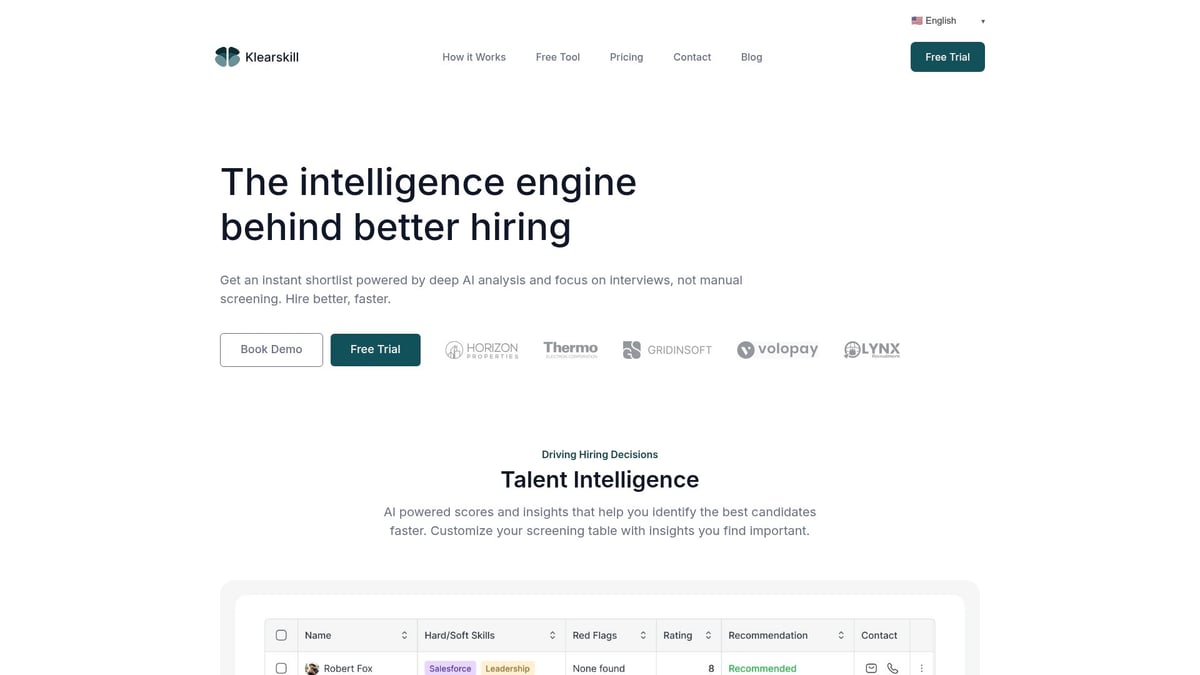
Klearskill users report up to 92 percent faster screening times, which means your hiring team can focus on high-value interactions rather than administrative work. With 97 percent match accuracy for technical roles, candidate fit is no longer left to chance. The platform’s advanced algorithms also drive a 99 percent decrease in unconscious bias, making your hiring process fairer and more inclusive.
Customizable analytics and seamless integration with your applicant tracking system ensure that your hiring workflows are both efficient and scalable. Recruiters now have access to actionable insights that support data-driven decisions, leading to better long-term outcomes.
Imagine a scenario where your hiring team receives a curated shortlist in minutes, complete with predictive success scores and diversity metrics. These measurable improvements not only save time but also elevate the overall quality of your hiring.
Overcoming Challenges in Tech Adoption
Despite the clear benefits, integrating advanced recruitment technology into your hiring strategy presents unique challenges. Many organizations face obstacles such as complex system integration, concerns over data privacy, and resistance to change among team members.
Successful adoption starts with a clear roadmap and strong executive sponsorship. It is essential to select platforms that align with your hiring goals and offer robust support for onboarding and user training. Regular feedback loops and open communication can help address concerns and ensure buy-in from all stakeholders.
Data privacy remains a top priority, so it is vital to work with vendors who comply with global regulations and provide transparent data handling practices. Your hiring process should incorporate periodic reviews of security protocols and system performance to minimize risks.
Continuous optimization is key. By monitoring usage metrics and soliciting user feedback, you can refine workflows and maximize the return on your hiring technology investment. This proactive approach ensures that your hiring remains agile and resilient in a rapidly evolving landscape.
Future Trends in Recruitment Technology
Looking ahead, the next evolution in recruitment technology will further enhance your hiring outcomes. AI will become more sophisticated, enabling even greater personalization and accuracy in candidate matching. Predictive analytics will anticipate workforce needs and skills gaps before they emerge.
Conversational AI platforms will streamline candidate engagement, providing real-time responses and tailored guidance throughout the application process. Skills-based hiring will gain momentum, shifting the focus from traditional credentials to demonstrable abilities and potential.
Global talent marketplaces will expand, allowing your hiring teams to connect with specialized candidates regardless of location. As these technologies mature, your hiring strategy must remain adaptable, leveraging new tools to attract and retain top talent in a competitive market.
By staying informed and embracing innovation, your hiring process will be ready to meet the demands of 2026 and beyond.
Enhancing Candidate Experience for Competitive Advantage
In 2026, the candidate experience has become a defining factor in your hiring success. Organizations are competing not just for skills, but for positive perceptions in the talent market. A single negative interaction can ripple through social platforms, discouraging future applicants and impacting your hiring brand. Research reveals that nearly 60 percent of candidates have abandoned an application due to poor communication or cumbersome processes. For your hiring strategy to stand out, you must prioritize transparency, responsiveness, and personalization at every touchpoint.
A seamless, engaging candidate experience is no longer a luxury. It is a critical driver of attracting and retaining top talent. Companies investing in candidate-centric hiring processes see up to a 70 percent improvement in offer acceptance rates and long-term retention. In a landscape where word of mouth and online reviews influence applicant decisions, optimizing your hiring journey is essential for maintaining a competitive edge.

Personalization and Communication Best Practices
Personalization is now at the heart of your hiring. Candidates expect tailored communication that acknowledges their unique backgrounds and motivations. Automated outreach tools can help maintain consistent updates, but the tone and content must feel authentic. Addressing candidates by name, referencing their specific skills, and providing meaningful feedback transforms the process from transactional to relational.
Maintaining timely, transparent communication is equally crucial. Informing applicants of next steps, expected timelines, and outcomes helps reduce uncertainty and keeps engagement high. Many leading organizations are leveraging candidate relationship management platforms to schedule personalized touchpoints, ensuring no one feels ignored or lost in the process. For further insights on best practices, you can explore Enhancing candidate experience, which details actionable approaches to creating memorable interactions throughout your hiring journey.
Ultimately, the right balance of automation and human empathy fosters trust. Candidates who feel valued are not only more likely to complete the process, but also become advocates for your hiring brand, regardless of the outcome.
Measuring and Optimizing Candidate Experience
To enhance your hiring continuously, you need to measure what matters. Key metrics such as candidate Net Promoter Score, application completion rates, and feedback response rates provide a clear picture of satisfaction and pain points. Gathering feedback at each stage allows you to spot bottlenecks and refine your hiring workflow in real time.
Data-driven improvements might include simplifying application forms, reducing interview rounds, or ensuring interviewers are trained in inclusive communication. Regularly reviewing candidate feedback and benchmarking against industry standards helps keep your hiring experience ahead of evolving expectations.
Companies that prioritize these metrics report significant drops in candidate drop-off and increased acceptance rates. By making candidate experience a core part of your hiring strategy, you create a virtuous cycle where positive interactions attract future talent and reinforce your reputation as an employer of choice.
Building a Future-Proof Talent Strategy
A future-proof talent strategy is no longer a luxury, it is essential for organizations determined to lead in 2026 and beyond. With rapid shifts in technology, workforce expectations, and competition, future-proofing your hiring is the key to sustainable growth. This section explores how to build agility, foster ongoing skills development, integrate DEI, and align your hiring practices with evolving business goals.
Upskilling, Reskilling, and Internal Mobility
To future-proof your hiring, prioritize a culture of continuous learning. The velocity of change in the workplace means yesterday's skills may not meet tomorrow's demands. Invest in upskilling and reskilling programs that empower employees to adapt, ensuring your hiring strategy is resilient.
Internal mobility is a critical lever. When you enable people to move laterally or vertically within your organization, retention rises and institutional knowledge is preserved. According to LinkedIn, companies with strong internal mobility programs retain employees nearly twice as long. Real-world examples show organizations that embed career pathing and learning platforms into their hiring processes consistently outperform peers on retention and engagement.
Consider creating personalized learning journeys tailored to business needs. Encourage managers to identify high-potential talent and provide mentorship opportunities. This approach transforms your hiring from a reactive process to a proactive engine for development.
Diversity of skillsets and backgrounds is also essential. Embedding inclusive practices, such as those outlined in Diversity hiring strategies, ensures your hiring incorporates a wide range of perspectives. This not only supports innovation but also helps meet future business challenges with confidence.
Leveraging Data for Strategic Workforce Planning
Data-driven insights are reshaping your hiring landscape. By leveraging analytics, you can anticipate talent gaps, forecast workforce needs, and set clear diversity goals. Smart data use allows you to monitor trends, benchmark against competitors, and measure the impact of talent initiatives.
Modern workforce planning involves more than tracking headcount. Use predictive analytics to identify future skill shortages and align recruitment with long-term objectives. For example, AI-based tools can analyze historical hiring data and market trends to recommend targeted sourcing strategies. Studies show that organizations using analytics in their hiring processes reduce costs and time-to-hire while improving quality of hire.
Integrating technology is not only about efficiency, it is about making informed decisions. Platforms that leverage AI, as discussed in AI's role in recruitment and retention, help remove bias, improve retention, and increase overall effectiveness. This strategic use of data ensures your hiring remains agile, responsive, and aligned with your business mission.
Aligning Talent Acquisition with Business Objectives
Achieving alignment between talent acquisition and business strategy is vital for future-proofing your hiring. Begin by engaging leadership to define organizational priorities and workforce requirements. This collaboration ensures that hiring decisions directly support growth targets, innovation, and market positioning.
Establish clear metrics to evaluate the impact of your hiring practices. Track quality of hire, retention, and business outcomes to demonstrate the value of your hiring investments. Regularly review and adapt your talent acquisition strategies in response to shifting market conditions or strategic pivots.
Foster open communication between HR, hiring managers, and executives. When everyone understands how your hiring connects to broader business objectives, you build a culture of accountability and shared success. This alignment positions your organization to respond quickly to emerging opportunities and challenges, ensuring your hiring strategy stays relevant.
A future-proof talent strategy demands continuous improvement. By integrating upskilling, leveraging data, and connecting talent acquisition to business goals, your hiring will remain resilient and ready for 2026 and beyond.
As you look to master the complexities of hiring in 2026, leveraging AI-driven solutions isn’t just an advantage—it’s a necessity. We’ve explored how technology can help you streamline candidate screening, reduce unconscious bias, and make smarter, faster decisions that truly align with your business goals. If you’re ready to put these insights into action and experience firsthand how AI can transform your recruitment process, I invite you to take the next step. Explore the possibilities and Start free trial to see how effortless building your dream team can be.


