
March 7, 2026
Job Scores: The Science Behind Candidate Rankings
Modern recruitment demands precision. When hiring teams face hundreds of applications for a single position, the challenge becomes separating qualified candidates from those who don't meet requirements. Job scores provide a quantifiable solution to this problem, transforming subjective hiring decisions into data-driven processes that identify top talent efficiently. This numerical approach to candidate evaluation has become essential for organizations seeking to improve hiring quality while reducing time-to-hire.
Understanding the Fundamentals of Job Scores
Job scores represent numerical values assigned to candidates based on how well their qualifications match specific position requirements. These scores create an objective ranking system that allows recruiters to compare applicants consistently across multiple criteria.
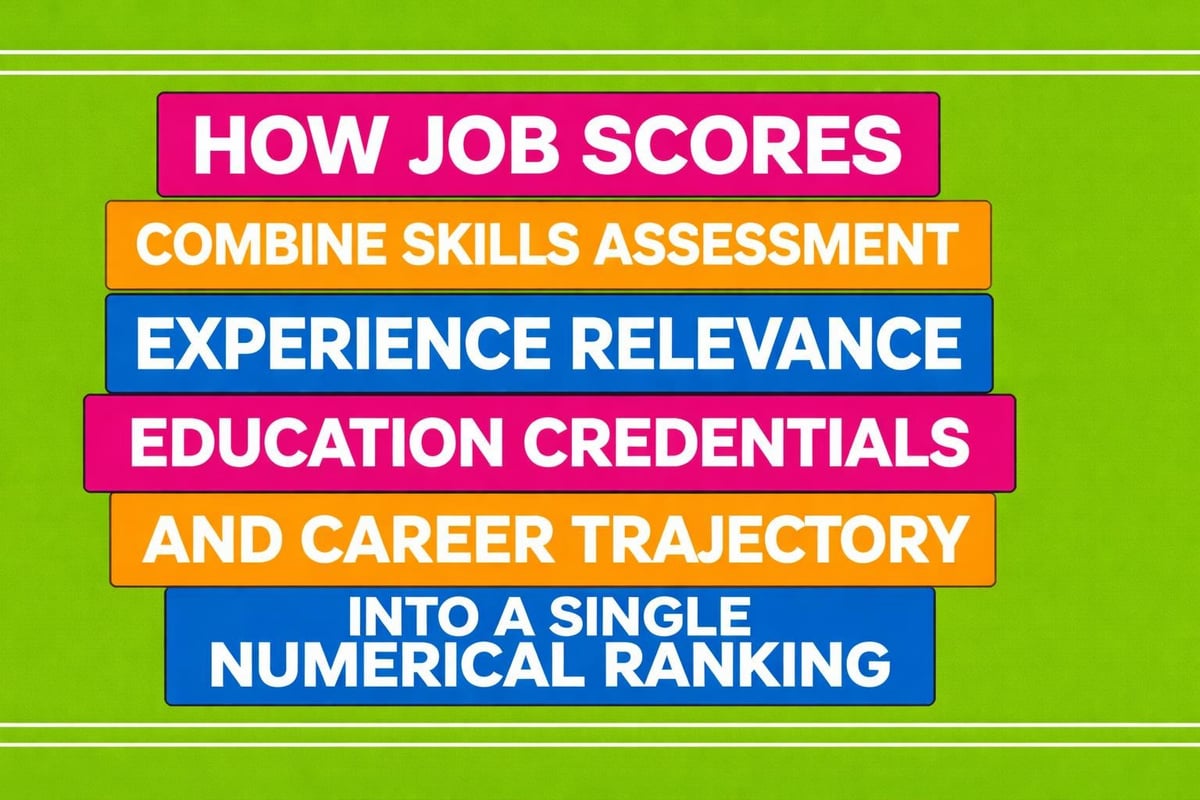
The foundation of effective job scores begins with understanding what factors contribute to candidate evaluation. Skills alignment forms the primary component, measuring how closely a candidate's technical abilities match those required for the role. Experience relevance adds another layer, assessing whether previous work history demonstrates competency in similar responsibilities. Educational background, certifications, and career progression patterns round out the complete picture.
Modern recruitment software transforms this evaluation process by automating score calculations. Rather than manually reviewing each resume, AI-powered recruitment tools analyze candidate profiles against predetermined criteria, assigning weights to different factors based on their importance to role success. This automation ensures consistency while dramatically reducing the time required to evaluate large applicant pools.
The Mathematical Methodology Behind Candidate Rankings
Creating accurate job scores requires sophisticated mathematical frameworks that account for multiple variables simultaneously. The scoring methodology begins with establishing baseline requirements for each position, then measuring candidate qualifications against these standards.
Weighted scoring systems provide the most nuanced approach to candidate evaluation. Each qualification category receives a weight based on its importance to job performance. Critical skills might account for 40% of the total score, while experience contributes 30%, education 20%, and additional factors like certifications or industry knowledge make up the remaining 10%. This weighted approach ensures that job scores reflect the true priorities of each specific role.
Statistical normalization becomes crucial when comparing candidates with vastly different backgrounds. Raw scores might disadvantage candidates from non-traditional paths who possess equivalent capabilities through alternative experiences. Automated resume screening software addresses this challenge by normalizing scores across different experience levels, ensuring fair comparisons regardless of career trajectory variations.
The selection ratio plays a significant role in determining optimal score thresholds. When many qualified candidates apply for limited positions, higher score cutoffs become necessary. Conversely, competitive markets with fewer applicants might require more flexible scoring approaches to maintain adequate candidate pipelines.
Percentile rankings offer another valuable dimension to job scores. Rather than absolute numbers, percentile scores show where each candidate stands relative to the entire applicant pool. A candidate scoring in the 85th percentile demonstrates stronger qualifications than 85% of other applicants, providing immediate context for hiring decisions.
Implementing Job Scores in Your Recruitment Process
Successful implementation of job scores requires careful planning and systematic execution. The process begins long before candidate applications arrive, starting with thorough job analysis and requirement definition.
First, establish clear competency frameworks for each role. Identify both required and preferred qualifications, distinguishing between must-have capabilities and nice-to-have attributes. Document these requirements in specific, measurable terms rather than vague descriptions. Instead of seeking "strong communication skills," define what strong communication means for that particular position, whether it involves client presentations, technical documentation, or cross-functional collaboration.
Next, assign appropriate weights to each criterion. Engage hiring managers and team members who understand role demands to determine relative importance. Their insights ensure that job scores reflect actual performance predictors rather than arbitrary measures.
Technology selection becomes the next critical decision. Recruiting automation tools vary significantly in their scoring capabilities and customization options. Some platforms offer rigid algorithms with limited flexibility, while others enable complete customization of scoring criteria and weights. JobScore provides comprehensive recruiting software with integrated candidate scoring features, though the level of AI sophistication varies across platforms.
Integration with existing applicant tracking systems ensures seamless workflow continuation. Job scores become most valuable when they feed directly into your established hiring processes rather than creating additional administrative overhead. Best ATS for small business solutions often include native scoring capabilities that eliminate data transfer between systems.
Testing and calibration represent the final implementation phase. Run your scoring system against historical hiring data to validate its accuracy. Compare job scores from previously successful hires against those who underperformed or left quickly. This retrospective analysis reveals whether your scoring methodology accurately predicts performance outcomes.
Validating Accuracy and Reducing Bias
Job scores promise objectivity, but their effectiveness depends entirely on the quality of underlying algorithms and criteria. Validation ensures that scores actually predict job performance rather than simply measuring irrelevant factors.
Predictive validity testing compares candidate scores against actual performance metrics after hire. Track whether high-scoring candidates demonstrate superior performance in productivity measures, quality standards, retention rates, and promotion velocity. Strong correlation between job scores and these outcomes confirms scoring methodology effectiveness.
Adverse impact analysis examines whether scoring systems disadvantage protected demographic groups. Even well-intentioned algorithms can perpetuate historical biases if training data reflects past discrimination patterns. Regular audits identify disparate impact, allowing immediate corrections before bias becomes systemic. Hiring Indicators' Reveal assessment tool emphasizes bias-free evaluations through data-backed science, demonstrating industry movement toward fairer scoring approaches.
Continuous refinement based on hiring outcomes keeps job scores aligned with evolving business needs. As roles change and new technologies emerge, scoring criteria must adapt accordingly. Quarterly reviews of scoring parameters ensure relevance and accuracy over time.
Transparency in scoring methodology builds trust with both candidates and hiring teams. While proprietary algorithms protect competitive advantages, general explanations of evaluation factors demonstrate fairness and encourage confidence in the process. Candidates deserve understanding of how their qualifications are assessed, even without revealing exact formulas.
Enhancing Hiring Team Collaboration Through Standardized Evaluation
Job scores transform hiring from individual judgment calls into collaborative, evidence-based decisions. This standardization creates common language and shared understanding across recruiting teams, hiring managers, and executive stakeholders.
Standardized evaluation frameworks eliminate confusion about candidate quality. When recruiters present shortlists, job scores provide immediate context about relative candidate strengths. Rather than debating subjective impressions, teams focus discussions on specific qualification gaps or development opportunities.
Interview evaluation forms and templates complement job scores by extending structured assessment beyond initial screening. While resume-based scores identify promising candidates, interview scores evaluate soft skills, cultural alignment, and behavioral competencies that paper credentials cannot capture. JOIN's hiring scorecards enable customizable templates that maintain evaluation consistency across interviewers.
Dashboard visibility keeps all stakeholders informed throughout the hiring process. Real-time access to candidate scores, application volumes, and pipeline progression enables proactive decision-making. When job scores reveal insufficient qualified candidates, teams can quickly adjust sourcing strategies or reconsider requirement flexibility.
Benchmarking against industry standards provides external validation of hiring quality. Understanding how your candidate pool's average scores compare to market norms reveals whether you're attracting top talent or settling for mediocre applicants. This competitive intelligence informs employer branding investments and recruitment marketing priorities.
Optimizing Score Thresholds for Different Hiring Scenarios
Not all positions warrant identical scoring approaches. Strategic threshold adjustment based on role criticality, market conditions, and urgency creates more effective hiring outcomes than rigid universal standards.
Critical roles with high business impact justify stricter score requirements. Executive positions, specialized technical roles, and customer-facing leaders merit higher thresholds because performance variations dramatically affect organizational success. These positions might require candidates scoring in the top 10% of applicants, accepting longer time-to-fill in exchange for quality assurance.
Volume hiring scenarios demand different calibration. When filling multiple similar positions simultaneously, slightly lower thresholds expand the qualified candidate pool without sacrificing baseline competency. The goal shifts from identifying the single best candidate to building a cohort of capable performers who meet essential requirements.
Market scarcity influences optimal scoring approaches significantly. When competing for rare talent in hot markets, insisting on perfect scores guarantees unfilled positions. AI tools for talent acquisition help identify candidates with high growth potential who might score lower initially but demonstrate learning agility and cultural fit that predict long-term success.
Urgency considerations sometimes override ideal scoring thresholds. Business-critical vacancies that threaten revenue or operations may require accepting candidates who meet minimum score requirements rather than waiting for perfect matches. In these situations, strong onboarding and development programs compensate for qualification gaps.
Geographic variations also affect appropriate thresholds. Positions in competitive metro markets attract stronger candidate pools with higher average scores than similar roles in smaller markets. Regional calibration ensures fair evaluation while acknowledging local talent availability realities.
Leveraging Machine Learning for Score Refinement
Traditional job scores rely on predefined rules and static weights, but machine learning introduces adaptive intelligence that improves accuracy through continuous learning from hiring outcomes.
Pattern recognition algorithms identify non-obvious success predictors that human analysis might miss. Perhaps candidates with specific certification combinations demonstrate 30% higher retention rates, or particular career progression patterns correlate with faster productivity ramp-up. Machine learning surfaces these insights automatically by analyzing hundreds of variables simultaneously.
HireScore's machine learning algorithm exemplifies this approach, scoring candidates based on role-specific factors while delivering data-driven rankings. These systems learn from each hiring decision, becoming more accurate as they process additional candidates and outcomes.
Predictive modeling extends beyond initial screening to forecast long-term employee success. Advanced systems don't just identify qualified candidates but predict which ones will become top performers, demonstrate leadership potential, or remain with the organization beyond typical tenure periods. This forward-looking perspective transforms job scores from simple qualification measures into strategic talent intelligence.
Natural language processing enhances resume analysis by understanding context and nuance that keyword matching misses. Rather than simply counting skill mentions, NLP evaluates how candidates describe their experiences, inferring depth of expertise from language patterns and achievement descriptions. This semantic understanding produces more accurate job scores than surface-level resume parsing.
Continuous model retraining prevents algorithm degradation over time. As job requirements evolve and labor markets shift, machine learning systems update their evaluation parameters automatically, maintaining scoring relevance without manual intervention. This adaptability ensures that job scores remain predictive even as business needs change.
Measuring the Business Impact of Score-Based Hiring
Job scores justify their implementation costs through measurable improvements in hiring quality, efficiency, and business outcomes. Tracking these metrics demonstrates ROI and guides ongoing optimization.
Time-to-hire reduction represents the most immediate benefit. When resume screening software automatically generates ranked shortlists, recruiters spend hours instead of days identifying qualified candidates. Organizations report 60-70% faster screening processes after implementing automated scoring systems, accelerating overall hiring timelines significantly.
Quality of hire improvements appear in multiple performance indicators. New employees hired through score-based systems typically demonstrate faster time-to-productivity, higher performance ratings in first-year reviews, and better cultural fit assessments. These improvements translate directly to bottom-line impact through increased output and reduced turnover costs.
Cost per hire decreases as efficiency gains compound throughout the recruitment funnel. Reduced time investment from recruiters, hiring managers, and interview panels multiplies across dozens or hundreds of annual hires. Additionally, improved hiring quality reduces costs associated with turnover, rehiring, and underperformance.
Candidate experience metrics often improve with transparent, efficient processes. Faster response times and clear communication about application status create positive impressions even for non-selected candidates. Strong candidate experience protects employer brand and maintains talent pipeline relationships for future opportunities.
Diversity and inclusion outcomes require careful monitoring to ensure job scores advance rather than hinder equity goals. Properly designed systems increase diversity by removing unconscious bias from initial screening, but poorly calibrated algorithms can have opposite effects. Regular demographic analysis of hired candidates compared to applicant pools reveals whether scoring methodology supports inclusion objectives.
Addressing Common Challenges in Score Implementation
Despite significant benefits, organizations encounter predictable obstacles when implementing job scores. Anticipating these challenges enables proactive mitigation strategies.
Resistance from hiring managers often stems from concerns about losing decision-making authority. They perceive algorithmic scoring as threatening their expertise and judgment. Addressing this requires clear communication that job scores inform rather than replace human decision-making. Scores identify promising candidates for deeper evaluation, while final selection incorporates interview insights, team dynamics considerations, and leadership assessment that algorithms cannot capture.
Over-reliance on scores creates another risk. Numbers provide false precision that can obscure important contextual factors. A candidate scoring slightly lower might bring unique perspectives or experiences that drive innovation. Balanced approaches treat scores as important inputs within comprehensive evaluation frameworks rather than absolute determinants.
Technical integration challenges arise when connecting scoring systems with existing HR technology stacks. Legacy applicant tracking systems may lack APIs for seamless data exchange, requiring manual transfers that negate efficiency benefits. Thorough technical due diligence during vendor selection prevents these integration headaches.
Data quality issues undermine scoring accuracy when resume information is incomplete, inconsistent, or outdated. Candidates who fail to update LinkedIn profiles or submit minimal resumes receive artificially low scores despite strong qualifications. Encouraging comprehensive applications and supplementing resume data with other information sources improves scoring reliability.
Score inflation can occur when candidates learn to game the system by stuffing resumes with keywords or exaggerating qualifications. Regular algorithm updates and verification processes during interviews help identify and correct these distortions before they compromise hiring quality.
Future Developments in Candidate Scoring Technology
The evolution of job scores continues rapidly as artificial intelligence capabilities advance and labor market dynamics shift. Understanding emerging trends helps organizations prepare for next-generation recruiting approaches.
Skills-based hiring increasingly replaces credential-focused evaluation. Rather than emphasizing degrees and job titles, modern scoring systems assess actual capabilities through skills taxonomies and competency frameworks. This shift opens opportunities for non-traditional candidates while improving job-fit accuracy.
Real-time labor market integration will enable dynamic score adjustments based on current supply and demand. When specific skills become scarce, scoring algorithms automatically weight those capabilities more heavily. Conversely, oversupplied qualifications receive reduced emphasis. This market responsiveness keeps hiring competitive without manual recalibration.
Behavioral assessment integration adds psychological dimensions to traditional qualification scoring. Personality traits, work style preferences, and cognitive abilities combine with skills and experience for holistic candidate evaluation. Score Recruitment's approach to personalized talent identification exemplifies this multidimensional thinking.
Blockchain verification could transform resume accuracy by providing immutable credential records. When educational achievements, certifications, and employment history are blockchain-verified, job scores gain reliability while reducing fraud risks. This technological foundation enables faster, more confident hiring decisions.
Predictive career pathing extends scoring beyond immediate job fit to long-term organizational value. Advanced systems project how candidates might develop over time, identifying not just qualified applicants but future leaders who align with succession planning needs.
Job scores have fundamentally transformed recruitment from subjective art into measurable science, enabling organizations to identify top talent efficiently while reducing bias and improving hiring quality. By combining mathematical rigor with artificial intelligence, modern scoring systems deliver unprecedented precision in candidate evaluation. Klearskill streamlines this entire process by using AI to analyze candidate CVs and generate ranked shortlists in moments, allowing recruiters to focus their time on engaging top talent rather than manual resume review.


